Showing posts with label Wayzgoose. Show all posts

Wednesday, October 20, 2010

Lillian Worley, Printer and Friend


One of the most delightful people I met through my dad’s involvement in letterpress was Lillian Worley. A letterpress printer with a passion for cuts, Lil had a contagious sense of fun. I first met her and her husband Parker, both printers, at the 1964 Munster Indiana Wayzgoose. It was Munster where she taught my sister and me how to spit watermelon seeds as we devoured melon from a nearby produce stand.

A year later at the 1965 Lansing Michigan Wayzgoose, Lillian had printed “Print Pox” signs. Designed to look like a quarantine sign, “Print Pox” was a tongue-in-cheek warning about contagious letterpress addiction. Lil enlisted my sister and me to help her hang signs on the doors of the strip motel where the convention was taking place. Giggling, the three of us sneaked around taping “Print Pox” signs on all rooms where the printers were staying.

Lillian loved cuts, especially large or unusual ones. I remember one Wayzgoose where she bought an enormous cut of the Statue of Liberty. The thing must have been 8x15 inches or larger. Everybody teased Lil that she’d never use it. But she sent a big folded piece through the APA bundle a few months later, decorated with that Statue of Liberty cut.

Lillian often wrote and printed humorous pieces. Below is an example, an honorary “degree” printed for me from the fictitious Deuceace University, and a reference to it in a Christmas card that same year. Notice that the “official seal” is from the Clearfield Wrecking Company!


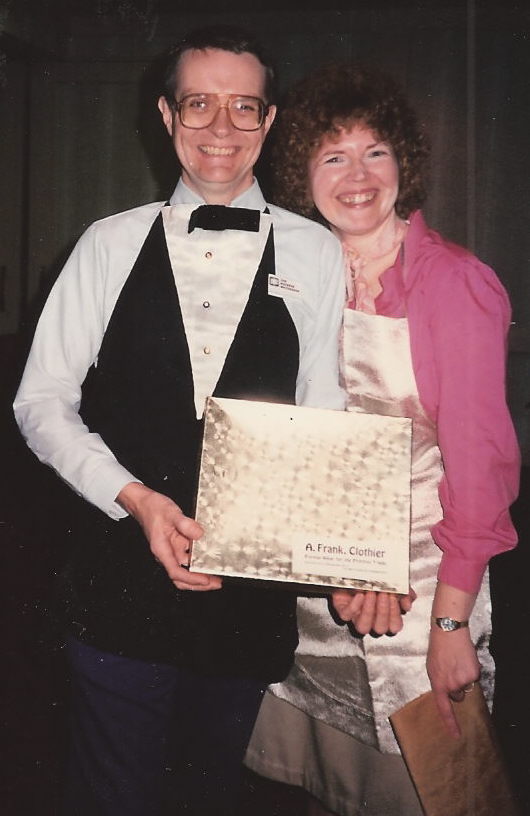
After my husband and I joined the APA together, Lillian presented us with dress printers' aprons. Bob's looked like a tuxedo, and mine was white satin. The hand printed label on the box said, "A. Frank, Clothier" -- a reference to printing warehouse dealer Al Frank.


In the early 1990s my husband and I visited Lillian and Parker in their Haddonfield, New Jersey home. We had a great time seeing their elegant carpeted press room, and taking an excursion to nearby Cape May. On that trip we hauled home in the back of our yellow AMC Pacer a 7x11 Pearl press they found for us. Despite the care the four of us took loading it, the weight of the press threw the car’s steering off. A torrential rainstorm on the freeway through Philadelphia made driving even harder, but we did get that press home and were grateful to have it.


Lillian was one of the earlier female printers in the Amalgamated Printers Association. At a time when most wives went shopping while the printers talked type, Lil hung out with the printers. She didn’t hesitate to paw through dusty offerings at Al Frank’s warehouse, to bid hard on auction items, or to hunt for bargains at the swap meet. She was an inspiration to me in that way, making it acceptable for me to be a girl and interested in printing.

I can’t imagine where I’d be today without Lillian Worley. I was a serious child, and she taught me how to laugh. She was a role model for me as a printer, and an absolute joy to know. Anyone who ever met her would never forget her. How lucky I was to have known her for so many years!

Wednesday, October 6, 2010

Printer's Knickknacks


Normally I’m not a fan of knickknacks that sit on a shelf and gather dust. But printer’s knickknacks are an entirely different thing. My husband and I have a small collection of whatnot items in our print shop that help to make the shop our own. True, they do gather dust, but....

Benjamin Franklin, that much admired printer and founding father, has a prominent place in our printing knickknack collection. We have a small bust of him, and a Ben Franklin “action figure” holding a kite with a key. We would rather have Ben holding a composing stick, but oh well. He has a miniature type case, but the compartments aren’t the right size – too even. To compensate we display “action figure Ben” next to a miniature common press which my dad got as a souvenir from the Gutenberg Museum in Mainz. Close by is a picture of my husband with Ben Franklin’s original press – the press was featured in an exhibit on Franklin at the museum where Bob works.

On the same shelf are pieces of type with jets that we cast; a Babcock Press paperweight; a miniature printing office, the “Liberty Falls Daily News”; Wayzgoose souvenirs, buttons, badges, and a typewriter ball; and in a small box, an 8 point piece of type with the entire Lord’s Prayer on it. This “Lord’s Prayer on a piece of type” was a promotional giveaway from American Type Founders, a huge American type founding firm. The words are actually legible under a strong magnifying glass.

Not to be forgotten are the pictures. We have a framed shot of my father Gary Hantke at the 1984 Wayzgoose in La Crosse, Wisconsin. Dad was in his glory there, having finally lured the Amalgamated Printers Association convention to our hometown. Wearing his APA cap and a shirt with reproductions from the MacKellar, Smiths, and Jordan specimen book, he beams out at us. Next to the picture of Dad, there’s a picture of my husband and myself at the 1994 Wayne, Michigan Wayzgoose, and a little trophy labeled “Famous Printer”, which of course we have to display.


Probably my favorite printer’s knickknack is one sewn by my mother and embellished by my dad: a printer’s doll, Cabbage Patch style. During the height of the Cabbage Patch craze, my parents produced 2 or 3 of these “printer’s dolls” for sale at a Wayzgoose. My mom sewed and stuffed the doll to look like a stocky guy with questionable fashion taste, adding checked pants, a polyester shirt, a visor and a printer’s apron. My dad created a miniature composing stick and line gauge for the doll, and printed “I Like to Print” on the apron. Needless to say, we are not parting with this particular knickknack soon.


Most of the stuff in our print shop is highly functional. But our printer’s knickknacks add a unique touch, showing who we are and where we’ve been. Personally, I couldn’t do without them!


One more knickknack, actually functional but too small to use much -- a miniature press. The platen on this one is 2 1/2 by 4 inches.

Wednesday, September 15, 2010

The Schori Press


One of the most interesting and delightful people I met as a child through my father’s association with letterpress was Ward Schori. Ward and his wife Marty lived in Evanston, Illinois when I first met them in the early 1960s. Ward ran a commercial printing business there called The Schori Press, but was also an enthusiastic letterpress hobbyist.

Enthusiasm was a defining term for Ward. He loved letterpress printing in its every aspect: designing and printing books, booklets, and ephemera; acquiring new type and cuts; and talking with others about printing.

Ward loved to talk, and he talked with his hands. I vividly remember riding in Ward’s car as he drove the freeways of Chicago, periodically taking his hands off the wheel to emphasize a point as he talked with my dad in the front seat. The mixture of enjoyment of Ward’s stories and absolute terror at the way he drove is something that will always stick with me. If the hands-free driving got a little too scary, Marty would gently chide him, “Now Ward, pay attention to the road.” That would last about five minutes, then Ward would be talking with his hands again.

Marty herself was a delight to know. An elegant woman with white hair in a French twist, she had a beautiful smile and a hearty laugh. I loved her wink, which she’d send my way every now and then. By the time I met them, Ward and Marty were grandparents. They raised their two grandchildren, who were about the same age as my sister and myself.


Together with my father Gary Hantke and his printing friend Emerson Wulling, Ward was a key organizer of the 1st Amalgamated Printers Association Wayzgoose in 1961. In those days the host provided food for the convention’s “picnic” that took place on Sunday. So Ward roasted a big turkey on his barbeque grill while Marty made side dishes, beverages, and dessert for all the printers in attendance.

At my first Wayzgoose in 1964 in Munster, Indiana, Ward encouraged me to enter the typesetting contest on the lawn in front of the motel. A case of type was set up on the tailgate of someone’s station wagon, and printers were timed as they set copy by hand, one letter and one space at a time. I was pretty young yet so I didn’t end up entering the contest, but I felt proud that Ward had believed in me.

In addition to regular sized books (he printed several), Ward became well known for his letterpress printed miniatures. He created over fifty of these intricate books, including some bound in hand-tooled leather from Spain. My husband and I are happy to have half a dozen Schori Press miniatures on our bookshelf today.

Part of the joy of being a hobby letterpress printer is getting to know other hobby letterpress printers. Ward and Marty Schori certainly stand out in my memory as two people I met through letterpress that I was privileged to know.

Title page of The Fortsas Bibliohoax, a private press book published by Ward Schori in 1986.

Six Schori Press miniature books and the full sized book "Printshop Nostalgia", all printed by Ward.


With the Schoris at the 1991 Wayzgoose in St. Louis, as we board the excursion boat "Belle of St. Louis". From left to right, Ward Schori, my husband Bob, Marty Schori, me, and my mother Ruth Hantke. Dad has just passed away the previous year.

Wednesday, July 21, 2010

Al Frank's "Boutique de Junque"


While attending the 1968 APA Wayzgoose with my family, I got the opportunity to visit a printer’s landmark now long gone − Al Frank’s printing supply warehouse at 947 West Cullerton in Chicago. I had to beg to go there with my dad and our printer friends the Worleys. The neighborhood surrounding the place was rundown and rough, not a place to take your teenaged daughter. But Lillian Worley helped me to talk my dad into it, and so the four of us set off.

By 1968 Al Frank’s “Boutique de Junque” was a well known printer’s mecca. In the printing salvage business since 1931, Al had stuffed five cavernous floors with presses, cutters, type, cuts, borders, galleys, and whatnot hauled in from print shops he bought. Everything was jumbled throughout the warehouse, but there was a rough order to the place: machinery on the first floor, wood type and miscellaneous on the second floor, metal type on three, equipment on four, and the overflow crammed onto five.

The building had its own character. Stairs and a balky freight elevator connected the floors. Plumbing was ancient and often non-functional. I felt lucky to be there in summer, since Dad had told me how cold the unheated building was in the winter months. The only way to warm up in winter was to join Al on the loading dock, where he burned junky cuts and beat-up type cases in an old 55 gallon drum.

The place was informal to say the least. There were no signs or price tags. You foraged through the warehouse, then brought things to Al, who’d squint at your pile of loot and name a price. I felt excited to be there, and was determined to help my dad find the good stuff. And I didn’t care how much dirt I had to plow through to do it!

I eagerly explored all five floors. Dusty type cabinets, heaps of galleys, skids of paper, and piles of standing forms mingled with old bathroom fixtures pulled out of print shops. In the middle of summer it was hot and sticky, especially on five. Pigeons cooed in the rafters and dotted merchandise with droppings. Never one to be daunted, Lillian Worley checked a metal rack swathed in plastic and discovered a line of women’s dresses. “You know, these aren’t half bad,” she said, laughing as she pulled one out and held it up for size.

As he always did at Al Frank’s, my father found typographical gold that day: a handful of old cuts, some beautiful borders, and a couple of quaint old typefaces half hidden in the dust and debris. And I loved being there, too. Visiting Al Frank’s was a huge thrill, a marvelous printing treasure trove that I wanted to see again. But as luck would have it, I never did. And in 1981, the big old warehouse burned to the ground. There was almost nothing left for Al’s son Jack Frank to salvage other than scrap metal.

The demise of Al Frank’s “Boutique de Junque” marked the end of an era of supreme typographical treasure hunting. But anyone who was there will never forget the place. What an adventure!

An early business card of Al Frank's, pre-dating modern telephone numbers and zip codes.

Wednesday, June 16, 2010

The Joys of the Wayzgoose


Can you think of anything better than getting together with a roomful of people who love the same printing hobby you do? Especially when some people wonder about the sanity of us hobby printers, hauling home tons of lead, cast iron, and heavy machinery, and tinkering with slivers of metal to form sentences and paragraphs, one letter and one space at a time.

At an APA Wayzgoose (printer’s convention) you have the opportunity to swap, sell, and salivate over type, cuts, presses, and whatnot. You meet printers with years of expertise that they’re happy to share. You meet new printers full of enthusiasm and excitement. You talk, hang out, meet and greet. Old friends are there, and new friends are there to be discovered. For one glorious weekend a year you eat, sleep, dream, and live letterpress.

Between attending printer’s conventions with my family as a kid and going to them with my husband as an adult, I’ve been to 27 APA Wayzgooses. Still it never gets old, and I never miss one if I can help it.

There’s opening day, the gathering of trucks, vans, trailers, and flatbeds. You chat in the hospitality room, sharing stories about the treasure trove of type you stumbled upon or the one that got away. There may be a chance to run old presses, tour another printer’s shop, or visit a printing museum or rare book room. You socialize late into the evening, talking with old friends, squinting at proofs of unidentified typefaces, meeting new people and asking about their interests and presses.

Saturday morning and the hunt is on! Swap meet tables fill with type, cuts, borders, galleys, books, quoins, presses, and whatnot. Buyers circle the tables all morning, snatching choicest finds first, returning to see what they missed, and in the last throes of the buying frenzy deciding they want that font of 8 point Stymie with only one lower case e after all.

Following lunch it’s the auction, a master performance of salesmanship and standup comedy. The auctioneers roll through the lots, ogling some and trying to figure out what on earth others are. Lots run the gamut from rusty galleys to rare fonts of 19th century wood type. There’s a steady supply of humor throughout and the bargains abound, with a few choice items bid to the skies near the end.

The final treat of the day is the banquet, a chance to enjoy a good meal and good conversation, learn more about printing technique or history from the guest speaker, and maybe if you’re lucky win one of the door prizes. Once again printers talk late into the night.

The next morning trucks, vans, trailers, and flatbeds disperse in all directions, sagging under their loads of metal and cast iron. And with fresh knowledge and inspiration, printers look forward to the Wayzgoose next year!

Warmest thanks to Austin and Jean Jones, hosts of the 2010 Huntington, West Virginia Wayzgoose at Heritage Farm – a great time was had by all!

2010 APA Swap Meet: Ky and Sara Wrzesinski ponder a purchase from Dave and Charlene Churchman, with John Deason looking on.

Auction at the 2010 APA Heritage Wayzgoose: Auctioneers Dave Peat and Dave Churchman work the crowds.

2010 APA Heritage Wayzgoose Hosts Austin and Jean Jones. Thank You!!!

Wednesday, June 9, 2010

Wayzgoose Bound!


When I was a kid, our family vacation was often a trip to the annual printers’ convention, or Wayzgoose. And what fun it was! My sister and I learned about printing, and met wonderful people in the process.

By the 1960’s my father Gary Hantke had joined the Amalgamated Printers Association, or “APA”, a group of hobby letterpress printers from around the country. 1961 was the first convention in Chicago. I remember my dad and his printer friend Emerson Wulling boarding the Burlington Northern train to attend. My sister and I were little enough to cry when Dad left.

By the time the 1964 Munster, Indiana convention rolled around, the printers’ convention had become our summer family outing. Dad loaded down the Mercury station wagon with type for sale. When the back end sagged, he moved type onto the floor of the back seat. My sister and I rode surrounded by piles of type next to the station wagon doors and on the hump between us. This made restroom stops at gas stations a challenge, but after awhile we got pretty good at vaulting over the piles of type to get in and out of the car.

In 1964 the APA printers’ convention was called a “picnic” by many. Wayzgoose, a historic term for an outing given by the master printer for his apprentices and journeymen, was just starting to be used. The Munster Wayzgoose took place at a strip motel across the street from a farmer’s market. Rows of rooms surrounded an open grassy area where the convention took place. Printers drove their cars onto the grass and unloaded them. There was no formal agenda. People talked shop and bought and sold type and equipment from the back of their cars. Ward Schori ran a type setting contest, and John Boulette dressed up as a clown to entertain the kids. Meetings were held outside, with mosquitoes in heavy attendance. The hosts provided Sunday picnic lunch for everyone. I still remember Elsie Boyd’s delicious potato salad.

For us kids there were other things to do. My sister and I went to the farmer’s market with printer Lillian Worley and bought a watermelon. We cut it open and sat on the curb eating it, laughing as Lillian taught us how to spit watermelon seeds. We had fun visiting Blanche Duerr, wife of printer Emerson Duerr, too. Blanche was a grandmother in her seventies then, but lively and full of fun. My mother, sister and I all learned to dance the Charleston in a motel room in Munster, following Blanche’s enthusiastic lead.

For over a decade, my family loaded up the car and went to the “Goose”. Once the swap meet started, my mother, sister, and I combed the tables. Often we’d see a great cut to show Dad. Mom would get terrific deals − people gave her ink, type, and cuts. She knew good stuff and could spot it quickly. We kids had our share of “finds”, too.

Today I still remember riding in our overloaded station wagon, looking forward to all the fun we were going to have at the Wayzgoose. Today my husband Bob and I look forward to the same thing. What a great weekend, talking printing, meeting people, seeing old friends, swapping type and cuts. This time of year it’s wonderful to be Wayzgoose bound!


Program from the first 1961 APA Wayzgoose in Chicago. The illustration was printed letterpress, using rule and bits of border.


Activities at the Chicago Wayzgoose in 1961.


Banner for a car antenna, from the 1964 Munster Wayzgoose.


Luke Cory kidding with John Boulette (Jo Bo the Clown) at the 1964 Munster Wayzgoose.