Showing posts with label APA. Show all posts

Wednesday, May 4, 2011

Letterpress for Mother's Day


Though not a printer herself, my mother Ruth was always a big supporter of letterpress. She had an eye for good design, too. Often my father Gary Hantke would have her proofread and take a look at a piece he was about to print. Mom would catch the typos and suggest a bit of white space here or there.

Mom became good friends with several of the printer’s wives, and enjoyed attending Dad’s annual APA printing conventions. Often she managed to charm free cuts, paper, or ink from vendors at the swap meets. Mom and Dad even took a month long trip to Europe with one of the couples from APA.


She was also a wonderful mother. My sister and I never lacked for attention. She sewed our Halloween costumes, Easter and Christmas dresses, and spring and fall wardrobes. She loved to garden and play the piano, and was an excellent cook whose homemade bread, coffeecakes and pizza were legend.

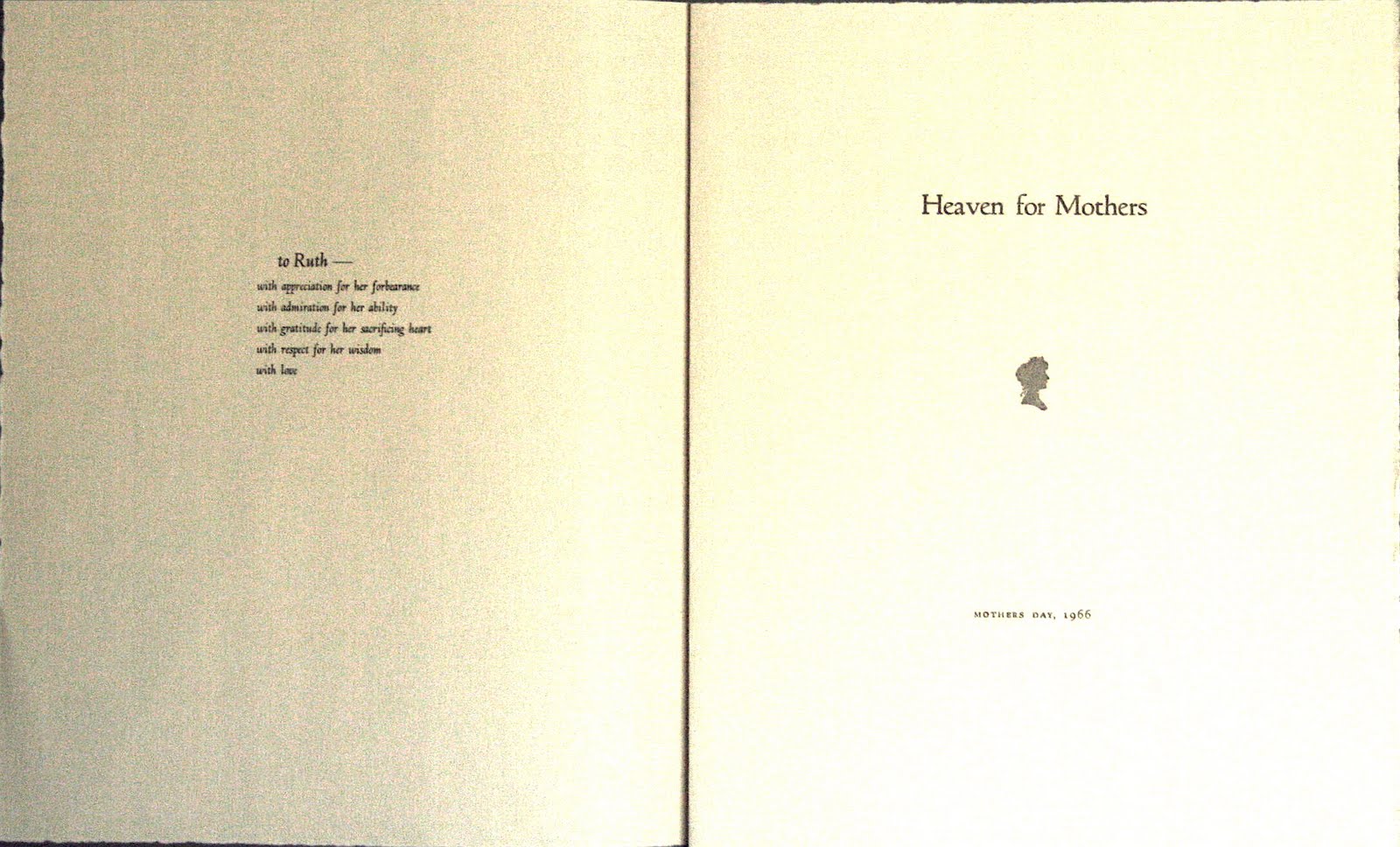
In 1966 Dad printed a lovely poetry booklet for Mother’s Day and gave it to her. All that setting and design work, and he just printed one copy ― for her. I found it with some of her papers after she died.


After my mother’s death in 2008, my husband and I printed a memorial piece in her honor. The type was Murray Hill, her favorite typeface, and the quote was surrounded by a border of flowers and musical notes.


I miss you, Mom! Thank you for all you taught me and gave me. And Happy Mother’s Day. Love, Carole

Wednesday, March 23, 2011

Printing for Treasure Gems


Treasure Gems, a bound 4 ½ by 6 yearbook of printing contributions by members of the Amalgamated Printers Association (APA) began in 1971, the same year I joined the group. It took me a little while to get going though – my first Treasure Gems piece was a quote from Emerson printed in 1978:


Over the years my husband and I have printed several times for Treasure Gems. It’s a great opportunity to showcase printed pieces. And since people collect and save Treasure Gems booklets, it’s one way to insure that your printing will be preserved and appreciated for many years!

Some of our Treasure Gems pieces have been historical, illustrating the use of a particular typeface. For example, the “Murder She Wrote” piece below talks about Art Gothic, an 1884 typeface that was also used for titling on the former television program.


We’ve done Treasure Gems pieces that show off border, too. Two below are for Acme Border, an early 20th century geometric from the Inland Type Foundry; and for Floriated Border, an eccentric 1890 concoction of flowers, twigs, and bark, designed by the Central Type Foundry.


One of our Treasure Gems pieces used an article from an old printing magazine. "Odor of a Printshop" talked about how printers get attached to the smell of kerosene, oil, and ink. They say printing gets in your blood, but in this case it gets in your nostrils!


Sometimes we've gotten whimsical, too. “American Types” was a poem published in a 1912 printing bulletin by American Type Founders, a typecasting company. Designed to be sung to the tune of “America the Beautiful”, the poem’s multiple verses celebrated ATF’s product ― a sneaky way to advertise. We thought it was kind of fun to sing the song, despite its occasionally clunky rhymes.


On the serious side, when a printer friend of ours died suddenly, we printed “Promise to a Printer” as a memorial piece. My husband wrote a “printerly” poem and we published it in memory of our friend.


Humorous or serious, historical or not, Treasure Gems contains some of the best printing from the Amalgamated Printers Association, the letterpress group I joined 40 years ago. And what a joy to work with other printers to create a booklet that will continue to be read and enjoyed years later!

Wednesday, January 26, 2011

Egdon Margo: Calligrapher, Printer, Wit


When I was in high school my family and I had the good fortune to meet a printer whose work we’d enjoyed for a number of years: APA printer Egdon Margo of Sherman Oaks, California. Known as Don to his friends, Margo was a professional calligrapher and private press printer with a quick wit, a love of letters, and a soft spot for helping budding printers and calligraphers get started.

Don Margo told us he first got interested in calligraphy as a serviceman during the blitz in World War II. During the bombing he took refuge in a London bookstore with a calligraphy display in the window. Afterwards he returned to study the beautiful hand lettering closer and decided to try it himself.

When I met Don Margo, he was well known in the calligraphic world, had won several awards, and made his living writing calligraphic titles and credits for the movies. He never mentioned much about that though. He was one of those people who was on fire with being creative: enthusiastic, animated, and full of fun. He loved calligraphy, he loved printing, and he loved talking with people. My father Gary Hantke called him, “Herr Schoenscriber”, or “Mr. Beautiful Writer” in German.

A Hollywood studio offered its stars calligraphic stationary. Don Margo did this sketch for the studio, and several were produced.

When I studied italic handwriting a few years later in school, Don Margo mailed me a large envelope full of samples of his work. Included was an article about him written in the 1950s, through which I learned more about how he got started with hand lettering. I loved how, tongue-in-cheek, he apologized for the picture of himself, “A thousand pardons for inflicting this ancient screen upon thee.”

Envelope full of calligraphic goodies sent to me by Don Margo.
Biographical article on Margo published in 1958.

Don Margo was a talented writer with a great sense of humor. His humorous bookmarks, and parodies on poems such as Jabberwocky and The Raven were the talk of the APA bundles. Among his favorite typefaces was Paul Hayden Duensing’s Sixteenth Century Roman. Below are several examples (click on any image to enlarge) of his printing and wit, courtesy of John Horn. Thank you, Don Margo, for being such an inspiration to me, as well as an absolute delight to know!


The humorous credo of Margo's press. On top of a great sense of humor, Don Margo had an amazing vocabulary.

Don Margo's original version of Typowocky, a parody of Lewis Carroll's Jabberwocky.

John Horn's 2010 reprint of Margo's Typowocky, with all typeface names printed in the type mentioned.

Wednesday, January 5, 2011

Salute to the Mailer!


As members of the Amalgamated Printers Association, one of the things my husband and I look forward to most is the bundle. This collection of letterpress pieces by members is mailed out to everyone in the organization monthly. To me, getting the bundle is better than opening a box of chocolates! You get to see what everybody’s been printing. You could say the bundle is the lifeblood of APA — it’s what keeps everything circulating from one printer to another.

Instrumental in getting the bundle out is the mailer. Whoever has the job receives all the printed pieces from members, then sorts and distributes them through the monthly mailings. It’s a big job! I know because I’ve worked with it twice. My father Gary Hantke was mailer a couple of times (for part of 1960, and again in 1973 and 1974). And my husband Bob and I were mailers in 2001 and 2002.

My sister and I learned the meaning of the word “collate” early, when Dad was mailer. Printed pieces were lined up on the kitchen table. Round and round we’d go, picking up one of each and adding it to the bundle envelope. Sometimes my sister and I would race, but Dad discouraged that because of the dreaded “double pick”— if you got careless and picked up more than one, that item could run out before you finished all the bundles. Then you had to search to see where you’d made the mistake. Helping Dad with the bundle was fun for me, though. I liked looking at all the printed pieces. Sometimes there were extra copies, and I got to have my own little bundle made up of the leftovers.

With positive childhood experiences compiling the bundle, no wonder I was agreeable when my husband and I were asked about taking on the mailer’s job. We tried to plan ahead as much as possible. We bought a big covered plastic bin to shelter incoming packages from the weather. We set up a hanging file folder system to gather pieces two or three times during the month before stuffing bundle envelopes. We thought we were set to go. But our tenure as APA mailers started out with a challenge and a half.

The January 2001 bundle, our first as mailers, was HUGE! The combination of holiday pieces intended for the December bundle and a Benjamin Franklin theme (in honor of Ben’s January 17th birthday) swelled the bundle to immense proportions. We gathered pieces, and gathered and gathered some more. The question was how to fit it all into the specially printed envelope with Ben on the front. Finally with careful layering, we got it all in. There wasn’t room for a scrap more! I’m sure very few people put their bundle pieces back into that January 2001 envelope after looking at them — once removed they sprang out and refused to go back in. It was quite the introduction to being mailers. Thankfully, no other bundle while we were mailers was as big as that first one!

According to APA’s website, over the club’s history 860+ people have been members, but only 23 people have been mailers. And without the mailer, APA wouldn’t be where it is today. So here’s a big salute to our 2009-2010 mailer Don Tucker, all of our former mailers, and to incoming mailers Ky and Sara Wrzesinski for taking on the job. You’ve truly made a difference — thank you!

Wednesday, October 20, 2010

Lillian Worley, Printer and Friend


One of the most delightful people I met through my dad’s involvement in letterpress was Lillian Worley. A letterpress printer with a passion for cuts, Lil had a contagious sense of fun. I first met her and her husband Parker, both printers, at the 1964 Munster Indiana Wayzgoose. It was Munster where she taught my sister and me how to spit watermelon seeds as we devoured melon from a nearby produce stand.

A year later at the 1965 Lansing Michigan Wayzgoose, Lillian had printed “Print Pox” signs. Designed to look like a quarantine sign, “Print Pox” was a tongue-in-cheek warning about contagious letterpress addiction. Lil enlisted my sister and me to help her hang signs on the doors of the strip motel where the convention was taking place. Giggling, the three of us sneaked around taping “Print Pox” signs on all rooms where the printers were staying.

Lillian loved cuts, especially large or unusual ones. I remember one Wayzgoose where she bought an enormous cut of the Statue of Liberty. The thing must have been 8x15 inches or larger. Everybody teased Lil that she’d never use it. But she sent a big folded piece through the APA bundle a few months later, decorated with that Statue of Liberty cut.

Lillian often wrote and printed humorous pieces. Below is an example, an honorary “degree” printed for me from the fictitious Deuceace University, and a reference to it in a Christmas card that same year. Notice that the “official seal” is from the Clearfield Wrecking Company!


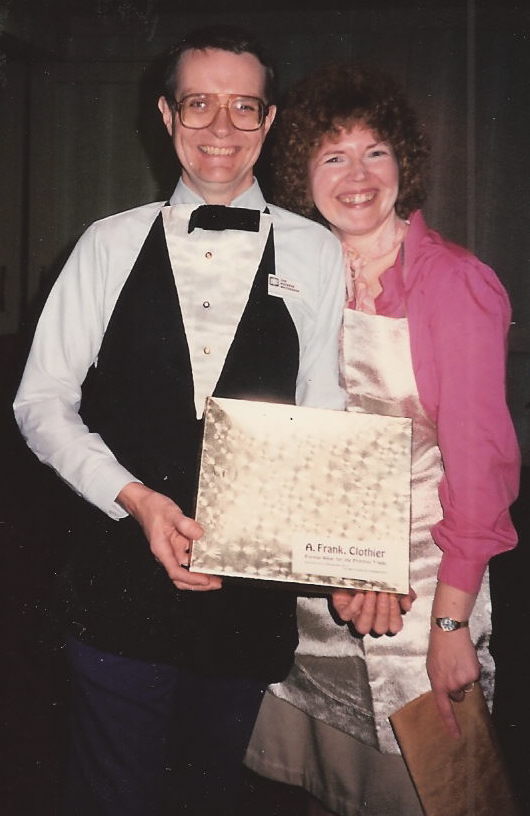
After my husband and I joined the APA together, Lillian presented us with dress printers' aprons. Bob's looked like a tuxedo, and mine was white satin. The hand printed label on the box said, "A. Frank, Clothier" -- a reference to printing warehouse dealer Al Frank.


In the early 1990s my husband and I visited Lillian and Parker in their Haddonfield, New Jersey home. We had a great time seeing their elegant carpeted press room, and taking an excursion to nearby Cape May. On that trip we hauled home in the back of our yellow AMC Pacer a 7x11 Pearl press they found for us. Despite the care the four of us took loading it, the weight of the press threw the car’s steering off. A torrential rainstorm on the freeway through Philadelphia made driving even harder, but we did get that press home and were grateful to have it.


Lillian was one of the earlier female printers in the Amalgamated Printers Association. At a time when most wives went shopping while the printers talked type, Lil hung out with the printers. She didn’t hesitate to paw through dusty offerings at Al Frank’s warehouse, to bid hard on auction items, or to hunt for bargains at the swap meet. She was an inspiration to me in that way, making it acceptable for me to be a girl and interested in printing.

I can’t imagine where I’d be today without Lillian Worley. I was a serious child, and she taught me how to laugh. She was a role model for me as a printer, and an absolute joy to know. Anyone who ever met her would never forget her. How lucky I was to have known her for so many years!

Wednesday, August 4, 2010

Chuckwagon Charlie and His Missus

A visit to the Duerrs' home on Myrtle Avenue in Elmhurst, June 1962: from left to right, my mother, my sister, me, my dad, and Emerson Duerr.


From left to right, my mother, my sister, Blanche Duerr, me, and my dad. This time Emerson took the picture.


Two wonderful people I remember from my childhood in the Amalgamated Printers Association were Emerson Duerr (APA 273), who often called himself “Chuckwagon Charlie” in print, and his spirited wife Blanche. I met the Duerrs about 1960, when my dad was making frequent trips to Chicago to visit rare book libraries and printer friends.

Emerson Duerr ‘s main press was a huge Golding Art Jobber with a balky fountain that gave him fits. His favorite cut was an electro of a Civil War era woman with a train in the background, which my dad dubbed, “The Lady and the Locomotive.” He used it on most of his printing.

Emerson Duerr had a dry sense of humor in person and in his writing. His dead-on W.C. Fields imitation would make my sister and I giggle every time. He was a lawyer, but his field could have been comedy writing. My entire family looked forward to his letters. He deliberately exaggerated and misspelled words, signing himself, “Yore ole frend”, and talking about himself and “his missus” as he called Blanche.

Here’s an example of his writing, from a cooperative piece printed during a 1968 visit to our home in La Crosse, Wisconsin. In it he talks tongue in cheek about APA bundle submissions:
“Some of our members would be better craftsmen if they were acquainted with the interior arrangement of Mr. Webster’s word garage and its most effective use. It was suggested we hire Mr. Webster on a per diem and mileage basis to visit our members and properly orient them. This was ruled out because Noah Webster died in 1843 and is no longer available for such employment.
Then it was suggested that our Mailer, who is a college instructor, be authorized to exclude from the bundle any contribution containing a misteak in spelling. This was loudly hooted down as an invasion of the freedom of speech.
But what shall we do about members who think erroneously that they are ‘hobbiests’? Professor Wulling, an authority on words, concedes that an amateur printer is a hobbyist, but it is possible that this ‘hobbiest’ business is an effort to distinguish between degrees of amateurism. Thus, ‘You are a hobby printer, but I am a hobbier printer, and he is the hobbiest printer of us all.’”

Emerson’s wife Blanche was a lively grandmotherly type, spunky and full of fun. Her stories and home cooking made it a treat to visit her and Emerson in Elmhurst. Blanche looked like a sedate older woman, but she was not to be outdone. I remember when my family was riding with her and a teenager pulled up next to her at a stop sign in Elmhurst. He revved his engine, and yelled, “Want to race, grandma?” The daughter of an auto dealer, Blanche knew cars. She warned us all to hang on. When the light turned green, she floor boarded her big Buick, leaving her challenger far behind.

Emerson Duerr was in his sixties when we met him, and already suffering from a heart condition. After his death in 1972, my father and his frequent printing collaborator Emerson Wulling produced a memorial booklet in his honor entitled “Yore Ole Frend, CWC”. I helped with the booklet, shown below.

One of the joys of printing is meeting other people who print. I’m so glad I had the opportunity to know “Chuckwagon Charlie and His Missus” – two outstanding human beings.


Cooperative piece printed during the Duerrs' visit to our home in La Crosse, Wisconsin, August 1968.


Memorial booklet for Emerson Duerr, produced by Gary Hantke and Emerson Wulling. "The Lady and the Locomotive" cut is featured.

Wednesday, June 16, 2010

The Joys of the Wayzgoose


Can you think of anything better than getting together with a roomful of people who love the same printing hobby you do? Especially when some people wonder about the sanity of us hobby printers, hauling home tons of lead, cast iron, and heavy machinery, and tinkering with slivers of metal to form sentences and paragraphs, one letter and one space at a time.

At an APA Wayzgoose (printer’s convention) you have the opportunity to swap, sell, and salivate over type, cuts, presses, and whatnot. You meet printers with years of expertise that they’re happy to share. You meet new printers full of enthusiasm and excitement. You talk, hang out, meet and greet. Old friends are there, and new friends are there to be discovered. For one glorious weekend a year you eat, sleep, dream, and live letterpress.
Between attending printer’s conventions with my family as a kid and going to them with my husband as an adult, I’ve been to 27 APA Wayzgooses. Still it never gets old, and I never miss one if I can help it.

There’s opening day, the gathering of trucks, vans, trailers, and flatbeds. You chat in the hospitality room, sharing stories about the treasure trove of type you stumbled upon or the one that got away. There may be a chance to run old presses, tour another printer’s shop, or visit a printing museum or rare book room. You socialize late into the evening, talking with old friends, squinting at proofs of unidentified typefaces, meeting new people and asking about their interests and presses.

Saturday morning and the hunt is on! Swap meet tables fill with type, cuts, borders, galleys, books, quoins, presses, and whatnot. Buyers circle the tables all morning, snatching choicest finds first, returning to see what they missed, and in the last throes of the buying frenzy deciding they want that font of 8 point Stymie with only one lower case e after all.

Following lunch it’s the auction, a master performance of salesmanship and standup comedy. The auctioneers roll through the lots, ogling some and trying to figure out what on earth others are. Lots run the gamut from rusty galleys to rare fonts of 19th century wood type. There’s a steady supply of humor throughout and the bargains abound, with a few choice items bid to the skies near the end.

The final treat of the day is the banquet, a chance to enjoy a good meal and good conversation, learn more about printing technique or history from the guest speaker, and maybe if you’re lucky win one of the door prizes. Once again printers talk late into the night.

The next morning trucks, vans, trailers, and flatbeds disperse in all directions, sagging under their loads of metal and cast iron. And with fresh knowledge and inspiration, printers look forward to the Wayzgoose next year!

Warmest thanks to Austin and Jean Jones, hosts of the 2010 Huntington, West Virginia Wayzgoose at Heritage Farm – a great time was had by all!

2010 APA Swap Meet: Ky and Sara Wrzesinski ponder a purchase from Dave and Charlene Churchman, with John Deason looking on.

Auction at the 2010 APA Heritage Wayzgoose: Auctioneers Dave Peat and Dave Churchman work the crowds.

2010 APA Heritage Wayzgoose Hosts Austin and Jean Jones. Thank You!!!

Wednesday, June 9, 2010

Wayzgoose Bound!


When I was a kid, our family vacation was often a trip to the annual printers’ convention, or Wayzgoose. And what fun it was! My sister and I learned about printing, and met wonderful people in the process.

By the 1960’s my father Gary Hantke had joined the Amalgamated Printers Association, or “APA”, a group of hobby letterpress printers from around the country. 1961 was the first convention in Chicago. I remember my dad and his printer friend Emerson Wulling boarding the Burlington Northern train to attend. My sister and I were little enough to cry when Dad left.

By the time the 1964 Munster, Indiana convention rolled around, the printers’ convention had become our summer family outing. Dad loaded down the Mercury station wagon with type for sale. When the back end sagged, he moved type onto the floor of the back seat. My sister and I rode surrounded by piles of type next to the station wagon doors and on the hump between us. This made restroom stops at gas stations a challenge, but after awhile we got pretty good at vaulting over the piles of type to get in and out of the car.

In 1964 the APA printers’ convention was called a “picnic” by many. Wayzgoose, a historic term for an outing given by the master printer for his apprentices and journeymen, was just starting to be used. The Munster Wayzgoose took place at a strip motel across the street from a farmer’s market. Rows of rooms surrounded an open grassy area where the convention took place. Printers drove their cars onto the grass and unloaded them. There was no formal agenda. People talked shop and bought and sold type and equipment from the back of their cars. Ward Schori ran a type setting contest, and John Boulette dressed up as a clown to entertain the kids. Meetings were held outside, with mosquitoes in heavy attendance. The hosts provided Sunday picnic lunch for everyone. I still remember Elsie Boyd’s delicious potato salad.

For us kids there were other things to do. My sister and I went to the farmer’s market with printer Lillian Worley and bought a watermelon. We cut it open and sat on the curb eating it, laughing as Lillian taught us how to spit watermelon seeds. We had fun visiting Blanche Duerr, wife of printer Emerson Duerr, too. Blanche was a grandmother in her seventies then, but lively and full of fun. My mother, sister and I all learned to dance the Charleston in a motel room in Munster, following Blanche’s enthusiastic lead.

For over a decade, my family loaded up the car and went to the “Goose”. Once the swap meet started, my mother, sister, and I combed the tables. Often we’d see a great cut to show Dad. Mom would get terrific deals − people gave her ink, type, and cuts. She knew good stuff and could spot it quickly. We kids had our share of “finds”, too.

Today I still remember riding in our overloaded station wagon, looking forward to all the fun we were going to have at the Wayzgoose. Today my husband Bob and I look forward to the same thing. What a great weekend, talking printing, meeting people, seeing old friends, swapping type and cuts. This time of year it’s wonderful to be Wayzgoose bound!


Program from the first 1961 APA Wayzgoose in Chicago. The illustration was printed letterpress, using rule and bits of border.


Activities at the Chicago Wayzgoose in 1961.


Banner for a car antenna, from the 1964 Munster Wayzgoose.


Luke Cory kidding with John Boulette (Jo Bo the Clown) at the 1964 Munster Wayzgoose.

Tuesday, January 5, 2010

Salute to the Mailer!


As members of the Amalgamated Printers Association, one of the things my husband and I look forward to most is the bundle. This collection of letterpress pieces by members is mailed out to everyone in the organization monthly. To me, getting the bundle is better than opening a box of chocolates! You get to see what everybody’s been printing. You could say the bundle is the lifeblood of APA — it’s what keeping everything circulating from one printer to another.

Instrumental in getting the bundle out is the mailer. Whoever has the job receives all the printed pieces from members, then sorts and distributes them through the monthly mailings. It’s a big job! I know because I’ve worked with it twice. My father Gary Hantke was mailer a couple of times (for part of 1960, and again in 1973 and 1974). And my husband Bob and I were mailers in 2001 and 2002.

My sister and I learned the meaning of the word “collate” early, when Dad was mailer.Printed pieces were lined up on the kitchen table. Round and round we’d go, picking up one of each and adding it to the bundle envelope. Sometimes my sister and I would race, but Dad discouraged that because of the dreaded “double pick”— if you got careless and picked up more than one, that item could run out before you finished all the bundles. Then you had to search to see where you’d made the mistake. Helping Dad with the bundle was fun for me, though. I liked looking at all the printed pieces. Sometimes there were extra copies, and I got to have my own little bundle made up of the leftovers.

With positive childhood experiences compiling the bundle, no wonder I was agreeable when my husband and I were asked about taking on the mailer’s job. We tried to plan ahead as much as possible. We bought a big covered plastic bin to shelter incoming packages from the weather. We set up a hanging file folder system to gather pieces two or three times during the month before stuffing bundle envelopes. We thought we were set to go. But our tenure as APA mailers started out with a challenge and a half.

The January 2001 bundle, our first as mailers, was HUGE! The combination of holiday pieces intended for the December bundle and a Benjamin Franklin theme (in honor of Ben’s January 17th birthday) swelled the bundle to immense proportions. We gathered pieces, and gathered and gathered some more. The question was how to fit it everything into the specially printed envelope with Ben on the front. Finally with careful layering, we got it all in. There wasn’t room for a scrap more! I’m sure very few people put their bundle pieces back into that January 2001 envelope after looking at them — once removed they sprang out and refused to go back in. It was quite the introduction to being mailers. Thankfully, no other bundle while we were mailers was as big as that first one!

According to APA’s website, over the club’s history 860+ people have been members, but only 23 people have been mailers. And without the mailer, APA wouldn’t be where it is today. So here’s a big salute to our 2009-2010 mailer Don Tucker, all of our former mailers, and to incoming mailers Ky and Sara Wrzesinski for taking on the job. You’ve truly made a difference — thank you!