Showing posts with label Xanadu Press. Show all posts

Tuesday, March 20, 2012

River Rat Printers


My husband and I have spent most of our lives along the Mississippi River, appreciating both old time letterpress printing and the romance of the steamboat era. We began in La Crosse, Wisconsin, moved downriver to Lynxville, Wisconsin, then to St. Louis, Missouri. We’ve learned that our twin interests are more linked than you might imagine: newspaper printing was the mass media of the 19th century, and riverboats a major form of transportation. The Mississippi was like a super highway in those days, and printers depended on it to deliver presses, type, and paper, and distribute news up and down the river.


As printers interested in history, we’ve done quite a few pieces relating to riverboats. Our first was “A Little Book of Steamboat Puns”, a small booklet of atrocious river puns we made up ourselves. Though the puns were bad, the booklet was nice. We gave a copy to the late John Hartford, musician and river lover, at one of his performances. Years later we met him again, and he actually remembered our booklet. Maybe it was because the puns were so awful.


While in St. Louis we became volunteers at the Golden Eagle River Museum, and got to use our riverboat cuts some more. We printed programs, name badges, and bookmarks for the group.


We also added to our riverboat cut collection through the generosity of Golden Eagle members. Irv Braun had worked for transportation printer Con Curran, and saved many railroad and riverboat cuts from oblivion when the company switched from letterpress to offset. And James Swift, known to everybody as Jimmy, was a writer and historian for the Waterways Journal, a St. Louis based river magazine. Jimmy bequeathed his collection of river cuts to us. Some of our cuts from Irv and Jimmy are shown below.


While in St. Louis, we actually had the opportunity to print on a steamboat. The Bibliographical Society of America hosted a Mississippi River cruise at its 2004 meeting. Bob and I hauled a Baltimorean table top press, paper, and supplies over uneven riverfront cobblestones and onto the boat, where we were offered a small, wobbly table to set up. We wondered if any of the attendees from major libraries and rare book rooms would want to bother printing our little bookmark. To our surprise, we had a long line. People were thrilled to have the opportunity to print something themselves.


Years later we once again find ourselves printing along the Mississippi River, this time back in our hometown of La Crosse. We’ve come full circle, and we wonder what links between letterpress printing and the river we’ll discover this time around!

Wednesday, August 31, 2011

Moving A Print Shop: Not For Wimps!


Moving a letterpress print shop is not for the faint of heart. It’s not something you undertake lightly, pardon the pun! Yet move a print shop we did, and not just across town but some 450 miles. It was an ordeal to put it mildly, but happily we and the shop emerged unscathed in the end.

The moving process began with packaging over 600 type cases, cut cases, galleys, and miscellaneous items for transit. We used cardboard and stretch wrap to protect type and cuts from spilling or being scratched up.


Here’s a shot of my husband Bob hauling type from the basement into a staging area in the garage of our old house. It was a major workout for him, with the obstacles of a narrow stairwell, doors in the way, and a hairpin turn at the top of the stairs.


Over several weeks, the garage filled. A hobby printing friend dismantled our 8x12 Chandler and Price press, 7x11 Pearl press, and Peerless Gem paper cutter for the move. We rented a truck, then a van to haul some of the paper, cuts, and type, then hired professional movers to do the rest.


Moving day came, and we hoped we were ready. Our four movers were big strong guys. They quickly set to work loading the shop and our entire household onto a moving van. The biggest challenge for them was getting our 8x12 C & P press up the stairs. Even stripped down, the press weighed some 500 pounds. I think the sound of it coming upstairs one step at a time (1-2-3... whump!) and shaking the entire house will haunt me for a long time.


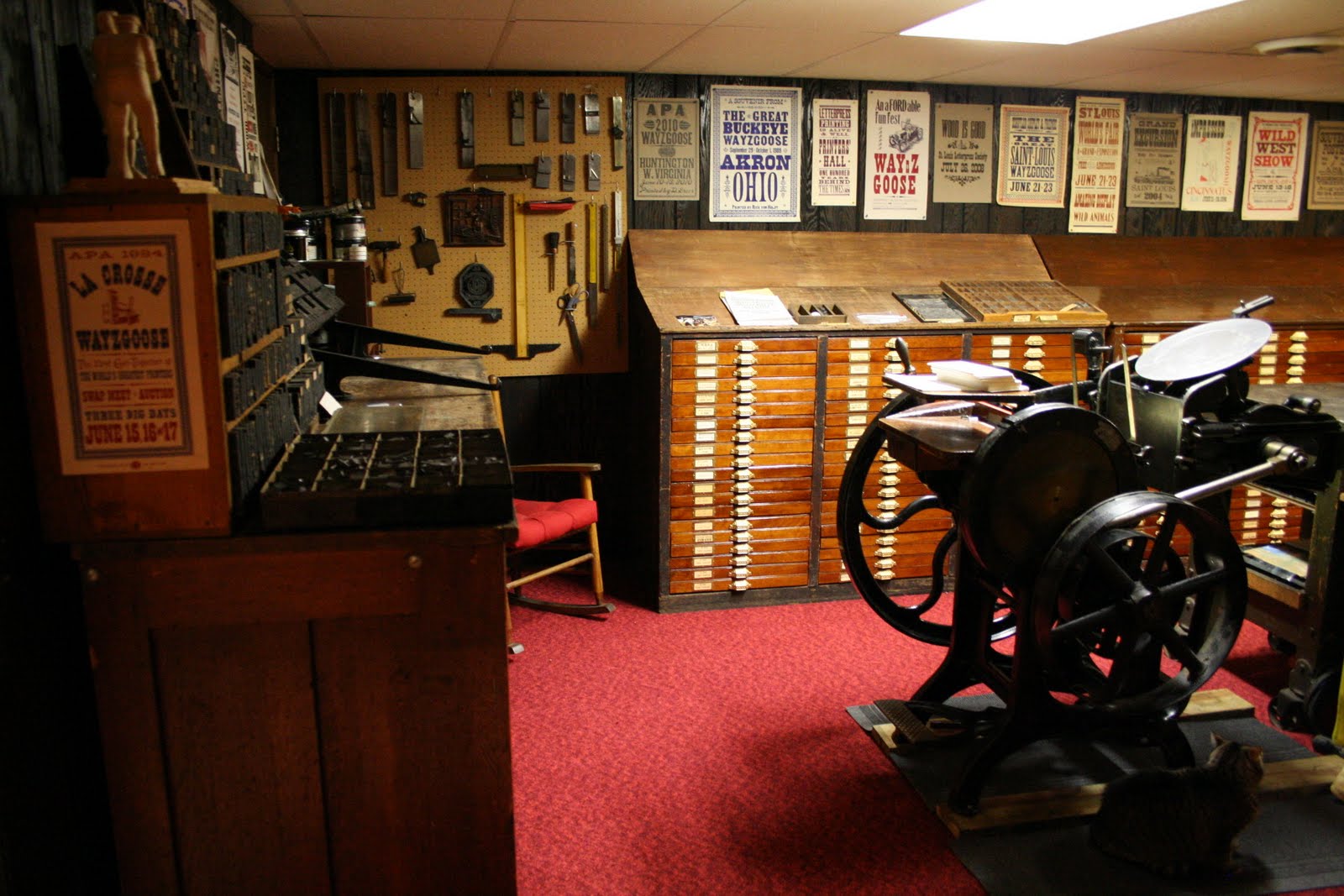
Meanwhile at our new house, we had to plan what to put where in the new printshop. Armed with our many measurements and painter’s tape, we arranged and rearranged. We figured once something was in place, we weren’t about to go moving it! We divided our print shop into three areas: the main shop downstairs, a print studio upstairs for designing and proofing pieces, and a paper storage space in the utility room.


The movers arriving and the unloading began. We were amazed how smoothly it all went. Most of the type cases were moved from garage to garage.


Over the next few weeks, my husband Bob began hauling type cases into the new print shop. It was easier going down with a wider stairway. We arranged, rearranged, unpacked, and fiddled with the new shop and print studio. It was a challenge thinking of how to set up two locations to operate efficiently, and one we’re still fine-tuning.


But here's our new, red-carpeted print shop, complete with autumn mural, and our upstairs printing studio. We’re finally ready to print, after over three months of moving the shop. And we have promised ourselves NEVER to move again! But all in all, it went well. Hooray, Xanadu Press is up and running!


Wednesday, March 9, 2011

Xanadu Press: Then and Now


Xanadu Press, my husband’s and my private press, was founded in 1971. Then single and still living at home, I attended the St. Louis APA Wayzgoose with my family. I’d been interested in printing for some time, and had spent a lot of time helping my father in his print shop. So when an opening came up in the Amalgamated Printers Association, I didn’t hesitate. I was excited and started to print right away. My first project was a proprietor’s card, or “prop card” for my new press (see above).

I’d always loved the poem “Kubla Khan” by Samuel Taylor Coleridge, which begins, “In Xanadu did Kubla Khan a stately pleasure dome decree...” So I named my press The Xanadu Press. By the way, Xanadu Press has nothing to do with that disco roller skating movie that came out in 1980!

My first printing efforts were modest. I printed a bookplate with a quote from William Blake. I did a holiday card, and a few Ben Franklin quotes. Then I decided to put together a small booklet of my poetry and call it Xanadu.


After our marriage my husband became interested in printing, too. My father Gary Hantke continued as a mentor to us both. Initially we lived in the same town and close to my father’s print shop, with its wealth of type, borders, and ornaments. But after we began moving in conjunction with our teaching careers, we acquired a 5x8 Kelsey hand press and a few type fonts of our own in the interest of portability.

It was then that we began to understand how difficult printing can be without the right equipment. We struggled with our little Kelsey press, trying to get a decent impression. Our main types were Cheltenham Bold and a little battered Caslon. It was hard to print something nice with so little variety.

We did create a small booklet called The Little Book of Steamboat Puns. It was notable mainly for the dreadful puns we came up with (for example: What do you call a 2000 pound steamboat thief? Robber Full-ton). In a fit of printerly pride, we gave a copy to the late musician and river enthusiast John Hartford at one of his concerts. He was very gracious, and actually remembered the booklet when we talked to him at a performance 15 years later. Maybe it was the awful puns that were memorable!


In the early 1980s we acquired a 7x11 Pearl press, hauling it in our AMC Pacer through a driving rainstorm in Philadelphia and back to our Wisconsin home. Now it was a little easier to print, especially since we’d bought more type from a printer in Lake Mills, Wisconsin. Living on the outskirts of a tiny village on the Mississippi River we were virtually rural, with a huge garden and beehives. We printed labels to sell jelly and honey at local farmer’s markets.


After our move to St. Louis in 1987, we became more active printers through our involvement with the St. Louis Letterpress Society and the APA. Following Dad’s death in 1990, we hauled most of his shop down to St. Louis in an exhausting move we’ll never forget (but more on that in a future blog!) We began printing items for our new St. Louis interests, some of which are shown below: a steamboat museum’s 50th anniversary program; a button for my husband’s museum co-workers after an exhibit installation; and a piece promoting the first of three APA Wayzgoose conventions in St. Louis.


Today we print more than we did in our earlier years. The lure of the print shop seems greater every year, with many projects to excite us. As Xanadu Press marks its 40th anniversary this summer, I’m grateful for all those printing opportunities, now and in the future.

Wednesday, June 23, 2010

A Printer's Daughter


So how did I get interested in printing? I was lucky enough to catch the printing bug from my dad, a longtime letterpress enthusiast. In both houses where I grew up, the printing press was in the basement directly below my bedroom. Dad was an insomniac, so most Saturday mornings the press was running by 6:00am. I’d sneak downstairs in my pajamas and go, “Whatcha doing, daddy? Can I help?” And he’d let me. As a little girl I put paper slip sheets between his printed pieces as he ran them off. From there I graduated to distributing type, with a diagram of the California Job Case in front of me. Then he taught me how to set type, first ragged right and then justified.

My first printed piece was a fairy tale I wrote when I was eight, called “What You Get Depends On What You Do”. With much help, I set the straight matter in 18 point (big type for little fingers). Dad set the title page and colophon, and did the lockup. Then he hand-turned the flywheel of the 8x12 Chandler and Price while I stood on a stepstool and fed each piece of paper to the press.

Growing up with a printer father meant I had birthday napkins with my name on them; a printed license plate for my blue pedal car; and when I got older, business cards for babysitting. I remember Dad and I printing a poster with antique type and a clipper ship for my history class, and a menu for a Latin club banquet. I liked to set and distribute type, so I was a good helper, or “printer’s devil”(printing apprentice). Plus I learned about design, lockup, and impression through watching Dad print.

One bigger project we did together was an ambitious Christmas card when I was in college. I wrote and set “Green is for Christmas”, and helped with cut choice and layout. Dad’s skill in printing the many multi-color cuts in the booklet was amazing to me. He printed a lot, almost every weekend and some weeknights, so I suppose his abilities grew with practice. As I look now at his earliest printed pieces, I can see his printing evolving. By the time I was learning, printing was second nature to him.

After I got married, my husband Bob caught the printing bug. We acquired our first press, a tabletop Kelsey which was hard to get to print well. The only way to get a decent impression was to pad the platen with Kleenex. We had our share of printing bloopers, including printing a piece on erasable bond typing paper with ink that refused to dry. Dad came to the rescue, offering an ink that would work with our dubious paper choice.

I was lucky enough to grow up with printer’s ink in my blood. Now I share the hobby with a husband who is equally enthusiastic. We’re happy to carry on a family tradition of printing just for fun!

My first printed piece, "What You Get Depends on What You Do".


Latin Club Menu cover. My Latin teacher also taught my father, and was a family friend.


Latin Club menu interior. Don't ask me what all we had: the main course was KFC with side dishes, but this menu made it look elegant.


"Green Is For Christmas": this card included five pages of text and five multicolor cuts.


"Green Is For Christmas" interior: Dad's ability to print in close register is something I admire to this day.